
A Plain-English Dye Sublimation Guide for Teams and Groups
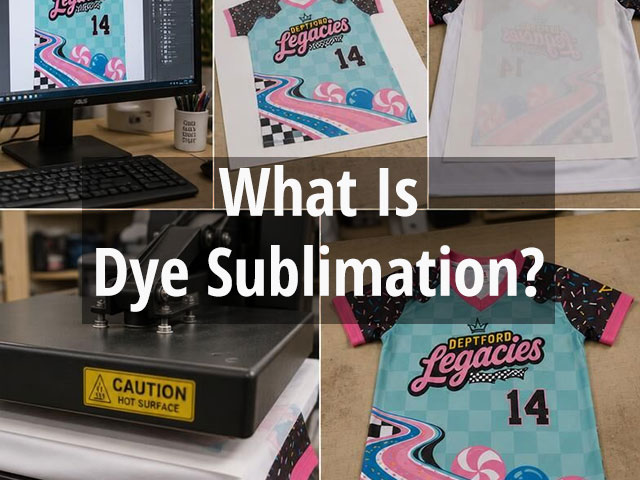
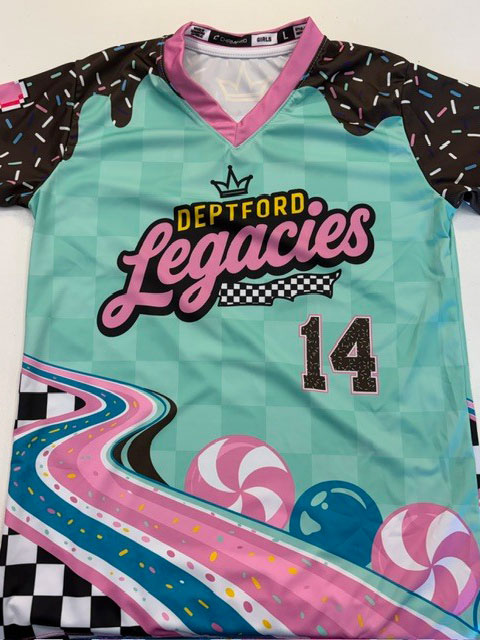
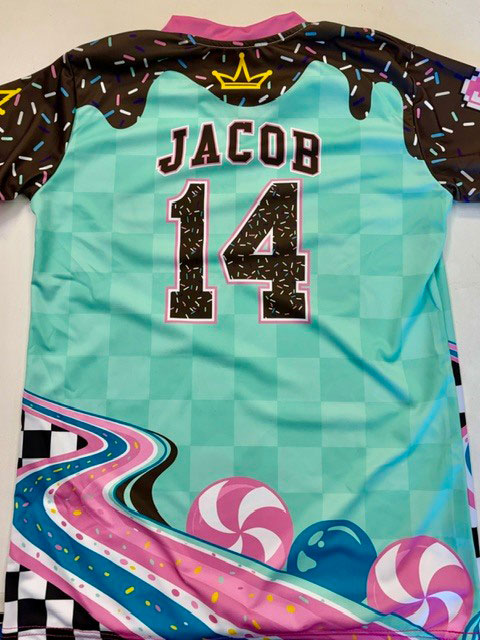
When the Deptford Legacies, a girls’ soccer team, came to us for Halloween tournament jerseys, they had a big idea. They wanted a candy-land design with frosting drips, sprinkles, swirled stripes, a checkered finish line, and every player’s name and number on the back.
Screen printing wasn’t the right tool for that much color and detail. Dye sublimation was.
If you’ve never heard the term, you’re not alone. Here’s what dye sublimation is, what it does well, where it falls short, and how to tell whether your project needs it.
How dye sublimation works
The design is printed with special inks onto transfer paper. That paper is placed against the fabric and run through a heat press. Under high heat and pressure, the ink turns into a gas and soaks into the polyester fibers. When it cools, the ink is locked inside the fabric.
That’s the big difference from screen printing, where the ink sits on top of the fabric as a layer. A sublimated print has no layer at all. Run your hand over it and all you feel is the fabric.
With sublimation, the design becomes part of the fabric instead of sitting on top of it.
What Gariel offers
We offer dye-sublimated apparel in these styles:
- Sports jerseys of all kinds
- T-shirts and long-sleeve shirts
- Sweatshirts
- Shorts and sweatpants
Our sublimation work is wearables only. We don’t currently offer items like bags, banners, or drinkware.
What sublimation does well
- It handles as many colors as your design needs. Gradients, shading, and photo-quality images all print cleanly.
- The design can cover the whole garment, including the front, back, and sleeves.
- Because the ink is inside the fiber, the print won’t crack, peel, or flake.
- The fabric stays light and breathable, which matters for athletes who sweat in their gear.
- Player names and numbers can be built right into the design.
Where dye sublimation falls short
- It needs polyester. Sublimation ink bonds with polyester fibers, so it won’t work on 100% cotton.
- The base fabric has to be white or very light. Sublimation inks are see-through, so they can’t cover a dark shirt. Your design can still be dark, because the dark colors are printed onto the light fabric.
- Polyester feels different from a soft cotton tee. Some people prefer cotton for everyday shirts.
- For a large order of a simple one- or two-color logo on cotton tees, screen printing is usually the more economical choice.
Sublimation or screen printing?
Sublimation is usually the better fit when you want:
- A design with lots of colors or fine detail
- Full coverage across the whole garment
- Lightweight jerseys or performance wear
Screen printing is usually the better fit when you want:
- A bold logo with a few ink colors
- Cotton or cotton-blend shirts
- Dark-colored shirts
- A large group order on a tighter budget
Have an idea? Let’s talk.
If your team or group has a design in mind and you’re not sure whether it should be sublimated or screen printed, call us at 856-848-3240 or email [email protected]. We’ll look at what you have and tell you which method fits.
Recent Comments